Recognize the fallacy of general statements and keep your clarity, understanding your own personal truth.
This is the core of what I call the Blue Hair Fallacy.
The story, as told by a preacher or minister in an Instagram post, went like this: he approached a member of his congregation and simply said, ‘I just don’t like your blue hair.’ The person, visibly offended, reacted strongly. Yet, they didn’t have blue hair. The preacher’s point was clear: the offense shouldn’t affected this person in his congregation because it didn’t fit for them.
This person, like so many of us, reacted not to the statement itself, but to the criticism itself even when it didn’t apply.
The meaning, is know yourself.
Here’s a practical example: this morning, in the midst of the usual school-run chaos, I mentioned,
‘It seems we’re perpetually five minutes late.’ Immediately, my daughter, who had been ready and waiting, retorted, ‘Why are you blaming me? I’ve been ready for ages!’
This is the Blue Hair Fallacy in action. She knew she wasn’t the cause of our tardiness. She knew she didn’t ‘have blue hair.’ Yet, my general statement triggered a defensive response.
This phenomenon is far more prevalent than we realize. Social media, with its carefully curated algorithms, amplifies it. The job of social media is not to agree with you; it’s to get clicks. It basically runs an algorithm to say, ‘I want this to really resonate with half of the population and create a strong emotional reaction or offense to the other half.’ That’s how we get clicks and likes.
My own father, a wise and very well read man, is constantly agitated by posts on his Facebook feed. He can’t resist engaging with content that contradicts his views. It’s the Blue Hair Fallacy playing out on a digital stage. He tells me about stuff that comes across his feet on Facebook. I tell him, “Dad, I don’t care about the stuff on Facebook, especially on your FB. If it doesn’t pertain to me and it doesn’t pertain to you, it’s none of my damn business with these other people think.”
I see it in social media with other friends of mine, I have even been guilty of it. Often presented as, “i know some of you all don’t like….”
But unless you’re a celebrity, I just don’t really think that fits. Maybe one or two people mention something but that’s what trolls do. They mention stuff, try to get under your skin. Make you reconsider what you posted and really who cares.
If it doesn’t apply to you, know yourself and then let it go.
Look for it in your own life. You’ll find it everywhere. And here’s the key: recognizing it is the first step to liberation.
If something doesn’t directly pertain to you, or even if it does but lacks real consequence, simply let it go. We live in a world saturated with stress and strife. Our brains, wired to solve problems, latch onto the smallest grievances when larger threats are absent.
The brain wants to protect!
Imagine an alien invasion. Suddenly, social media debates and minor slights would fade into insignificance. Real, immediate dangers would take precedence. The mundane and smaller issues that seem to aggravate us in our life are disregarded because it isn’t an immediate threat. That’s just how we are wired. We always have something in our life that needs fixing, despite the fact that we live in probably the safest, healthiest, and best time in human history, we tend to think that these are bad times. This is us. It’s not that there’s an actual problem.
it’s almost never how things are that bothers us, It’s how we feel things should be.
My wife and I have discussed this concept for years. When life throws true hardship, petty offenses vanish.
This morning, the Blue Hair Fallacy became crystal clear. It was a concept I’d seen play out, but never fully articulated. It was like simplifying a complex idea into a three-word philosophy, something I’ve found immensely helpful in my own life.
This aligns perfectly with my approach to understanding complex ideas. I’ve been doing this subconsciously for years and now, with my website Be Awesome 365 (which, admittedly, has been a bit neglected lately, but this idea felt too important to share), I’m reminded of the power of simplifying concepts.
In fact, this approach is central to my upcoming book, “Unlocking Athletic Potential.” In athletics, this concept is crucial. When I address my entire team and say, ‘We aren’t playing defense well,’ the player who’s excelling defensively needs to understand the intent of my statement without taking it personally. They must recognize that the general statement doesn’t apply to their flawless performance, much like someone dismissing a ‘blue hair’ comment when they don’t have blue hair. This is the core of effective communication and team dynamics, and it’s a principle I explore in depth in my book.
So, start noticing the Blue Hair Fallacy in your daily interactions.
Smile to yourself, knowing you possess the ‘inside secret’ to navigate the noise. It’s a superpower—the ability to choose peace in a world determined to provoke. And perhaps, it’s a superpower we can apply to more than just our social interactions, but to how we approach learning and growth in all areas of life, including unlocking our athletic potential.
Recognize the fallacy of general statements and keep your clarity, understanding your own personal truth.
Like many of the podcasts/articles I do, this idea had to originate somewhere. In this case, from a fortune cookie. Actually a meme of a fortune cookie. As much as I was kind of an anti-meme person a few years ago, it is funny how much these have grown on me.
Brevity is an art, and it is something I struggle with. Memes are perfect at this and make me better. I have an entire photo album of them on my phone.
“I don’t throw shade. I throw shine.”
Not something I thought about when I first read it, just one of those I scrolled through and passed on by.
But my brain works a little differently; somewhere throughout the night, that sentence embedded itself in my brain.
For those of you who know me, you know me as a pretty positive guy. Even the head of our youth soccer calls my wife’s and my coaching style “The Positive Peters.” It’s just weird all the way around, but it’s a compliment. I’ll take it.
The principal at my kids’ school, Miss Tara, also has commented to me a few times about how positive I am.
And, when it has anything to do with coaching or kids, 95% of the time, I will be almost pukingly positive.
But there’s still that 5% of the time. Ask my wife. Nobody can be on all the time.
My favorite type of comedy is snarky, poke fun at people, don’t have your feelings hurt, we’re just throwing something funny out there. Sarcastic, Seinfeld, Chappelle, Will Ferrel style. These guys tend to be the best at making fun of themselves, and therefore it’s OK to make fun of others if it’s humorous.
But what about the guys that we don’t have any action interaction with? Making fun of people I don’t know or have never met?
Almost every day when I drop my son off at school, I see a few kids who don’t fit my family norms. Weird kids, dressed in weird clothes, acting weird. It’s been a part of high school for eons.
High school is the ultimate in cliquey settings as it’s the exact time of the most social experimentation in identity, style, preferences, friends, interaction, and a million other factors of life. It’s the apex of “trying to figure out where you fit” as well as the all-time most pressure cooker situation that makes it feel more real than it most certainly is.
It’s also a sociologist’s fun zone. Because people who hang out together even unconsciously start to copy each other. Style, clothes, the way they walk and talk…it’s called “Homophily” summarized as “birds of a feather flock together.”
And when I see the goth skater chick with 17 pierces and dark eyeshadow, it’s a tossup of what I think to myself.
Some days I think, Man, I wonder what’s going on that’s so dark in her life, sometimes I chuckle and think South Park got their characters spot on, and sometimes I applaud her drive to push the boundaries and test reaction.
It depends on the day I’m having, probably more than anything else.
And I think that’s honest. Look, nobody was more 1990’s stereotype “superjock” than I was. I didn’t see the humor in the movie, “Friday Night Lights.” I thought they should go for the win. Much like the comedians mentioned above, I feel it’s okay to chuckle in my own head as I’m also a walking, breathing stereotype.
Ok, enough science.
What my point is, we all throw Shade- even if we’re just thinking it. At HEB, at work, at life. I think it’s how humans are wired. Find anomalies and then “see them.”
This morning something changed in my head because that meme was rolling through my brain, and all the strange, weird, eclectic kids that I saw at drop-off were coming at me from a different head space. Today, I thought, “These guys and girls are strong and unique. They are trying to figure out their own personal style. That’s not easy to do, especially in high school.”
I threw Shine, not shade. And it felt better.
Like so much of the stuff on this website, many of the things I’ve played with in my life and noticed a benefit from revolves around things that I would have chalked up to new age, granola, pseudo-hippie stuff a few years ago.
At about 40 years old, I became really big into wanting to try new things, learn new skills, and devouring updated and modern information. The funny thing is, much of it is ancient.
Stuff that seemed weird until I tried it, and it works.
And there’s no doubt in my mind positive thoughts Reflect better with our physical body.
So I’m going to go out of my way to try to throw shine. As an experiment and just because it’s a good thing to do. Of course, the added benefit of “It makes me feel good” doesn’t hurt.
Our brains are wired to find the bad, the scary, and The not-normal. I teach this in tactical settings and even have a chapter on this as security in my parenting book.
So find it, and then label it with something positive when applicable. I’ve only been playing this for a couple of days, so I don’t have any long-term results.
I do, however, have a strong belief that this is going to do a lot to rewire and set the tone for my brain. Over the last few months, my articles like “The Internal GPS, Best Burger, Paul’s Beer Review,” and others talk about listening to the subconscious, and my subconscious tells me it wants more positive, so I’m going to feed it what it’s craving.
My oldest son is like this. He has a very hard time saying something negative about anybody. Even the guys that he particularly doesn’t like, he’ll simply say, “They’re not my style.” and that’s enough. He doesn’t get into personal attacks on people and I love him for it. I can tell he’d like me to keep my mouth shut and probably would vocalize it exactly like the fortune cookie. “Dad, throw more shine, less shade. Bruh?!”
There’s a unique situation that happens in the modern world at the high school level of Athletics that I think a little bit of discussion would dramatically help with:
Your kids and how they deal with the athletic trainer at their school.
And by your kids I mean; your kids, you, the doctor or PT you use, and how you handle the entire episode.
As the guy that based his entire professional career on his relationships with some fantastic athletic trainers and sports docs he met during my sports career, I can’t stress to you enough the importance of building a good relationship with your athletic trainer.
As college athletes, Nikki and I LOVED our athletic trainers. We wanted their job. That is of course until we saw what their job entailed. Then we wanted a similar job with the same direction and protocols but done in a different way. Damn, those Athletic trainers work! Hard.
So This goes for you as an athlete but also as a parent.
Even if you aren’t on a first-name basis with your athletic trainer, know this. These guys/girls are here to go to bat for your kid in a time of need. They are there for protection, treatment, workups, and as a first line of treatment in an emergency. This year more than at any other time in history, it has been shown that ATs make a difference. They save lives, speed recovery, win super bowls, change protocols and care. They care man!
They aren’t out to make your kid sit on the bench and miss playing time.
We are in a very fantastic time in history – safer, healthier, more access to entertainment, less starvation and poverty worldwide, medical care is accessible – even at the high school level, most districts have an Athletic trainer right there on staff, typically at each game and with a full functioning clinic just down the hall from the locker room.
It is a fantastic first line of sports medicine care.
Having that doesn’t always make for perfection, however.
Some nuances are quite distracting and tough and make easy to go to “right answers” tough.
This article is not an attempt to fix all problems in all cases because that’s what I feel is a massive problem in the world. Each case is different. Oh, they aren’t all unique per se – Do this work for a decade, and you’ll start to pick up on trends, see a lot of repeats, and get a system. I certainly hope so. Every profession should get more efficient and better at categorizing as they get more experience. Athletic trainers, coaches, administrators, sports-based chiropractors, orthopedic surgeons, and everyone in the sports medicine universe should be able to come up with a Direction within the first minute of evaluating and watching an athlete and injury. That’s common sense.
Let me dive just a little bit deeper.
As a sports-based chiropractor, I interact with athletic trainers from all sorts of different districts with different policies and different personalities daily I have my favorites. I have the ones that are easier to work with. But I also have the ones that take a specific response and reaction, and I am constantly evolving the way that I handle each and every one of these relationships.
Being stubborn and just stating in stone: “I’m going to handle them all the same way.” is not only being selfish and nonpliable but is a sure way to get many things wrong.
Just like every profession, the interaction between athletic trainers, coaches, and anyone in the sports medicine team needs to be individualized and personalized. That’s true with the athletes, parents, radiologists, PT’s and orthos as well, It’s about relationships.
So I’m going to give you a scenario that I go through nearly daily.
Where you fit in on the Spectrum is entirely a matter of perspective.
An athletic trainer with specific guidelines and protocols and legal liability needs that have to be followed will have a different perspective than the mom who just wants her kid to play in the game on Friday. The doctor, pediatrician, chiro, or PT in the loop will have another, and let’s not downplay reality. The athlete, who by far and away is the most critical person in this equation, will have a different perspective that may change hour by hour based on ideas such as pain, the opportunity for play, team, drive, stubbornness, fear, as well as a million other emotions and thoughts that are in fluctuation faster in adolescents than we can even remember or comprehend.
In nearly every article I write, I talk about AWARENESS and how important it is. How we function in all aspects of life based on our awareness. A different perspective gives us better awareness and lets us make better decisions.
As much as I would love to have some discussion and would love to see some chats after one of my articles – just take a second to think it through from at least three perspectives before you write in the comments section. THEN….please write. I’d love to scenario strategize.
Let me set up a few scenarios as I feel Learning happens quicker with examples.
A high school track athlete goes to their athletic trainer with low grade back pain after a basketball practice.
“My back hurts.”
The athletic trainer states:
“We have a policy at this school. If your back hurts, understand that you are at the age that a stress fracture at the lower lumbar is a fairly frequent problem. You need to sit out until you have been evaluated by an orthopedic surgeon or someone that can sign off on a form saying that you do not have that issue.”
The kid is out of sports from that second on. That stinks. But it can happen. It does, and at some schools, that is THE actual protocol. For damn near every issue.
The reality is:
That’s a fair protocol. Nothing the athletic trainer said is incorrect. However, there was no exam or evaluation. In a case like this, there’s a strong possibility that if one minute would have been utilized to better evaluate an athlete, I think a better decision could have been arrived at quicker. Athletic trainers are well-trained and have mountains of experience with low back pain in athletics. They can and do judge and are way better at this kind of decision than anyone gives them credit for. So when I hear this, I cringe. “C’mon man, make a better decision!”
Contrastingly, as someone that does this for a living daily and has two decades of experience, I can almost guarantee you, examination and evaluation questions such as “Show me where it hurts, Grade the pain on a scale of 1 to 10, can you bend over?” Arent sufficient enough to truly make a good call as to the athletes state of being.
So what’s the right answer? Every single kid that has back pain needs an MRI?
The truth is MRI isn’t even the right call for MOST back pain. It’s used. It’s looked at as THE ANSWER. But it’s just not. It can show some things that we cant evaluate but it’s simply a picture, much is lost as a picture doesn’t show MOST.
The reality is that MRI probably takes two to three weeks to even set up. They are expensive. It’s most likely Overkill as nearly every single athlete has back pain at some time anyway and even could lead you down the wrong path. Its needed and I use is multiple times per week. But for every case? Even if it was free and took seconds…No. It’s not the only factor in proper decision making.
Like I said, it’s a case-by-case issue.
The honest reality is that a complete examination, evaluation, and treatment may allow us to decide on a treatment protocol that might show some results. We can then use these ideas to make better decisions but only after seeing if the athlete has responded to our care. I say daily, “We’ll know a lot more after seeing how this guy responds to the treatment.””
Just like the MRI may be overkill, sending that kid to a chiropractor or physical therapist who demands 16 sessions and four weeks of therapy before returning them to Competition damn near cuts off their entire season. Most likely, it is overkill. Unneeded.
Yet there is always the potential that something more serious is going on and as a parent, coach, coach, AT, or doctor we want to make sure that we can discover any issues as early as we can to protect the athlete and maximize their return.
That’s why policies are in place. Bureaucracy. Better ideas -only, a slower timeline.
This is why I have no hair.
Because in the everyday situation I explained above, the reality is this: If this “referral cascade” happens repeatedly in an athletic training situation in high school, parents, athletes and coaches will often start to avoid the AT.
Every day I get a call from an athlete who has an issue that has not seen the athletic trainer and the parents directly ask me not to speak with the athletic trainer on this case. Even though by working together, we can maximize the recovery time and the safety for the athlete, they want to have their kid to be seen “out of the loop.” Typically in an effort to speed their return to play.
Now let me add some more reality.
In the case above, the athlete who has hurt her back and goes the athletic trainer.
What changes if the report that the athlete gives the athletic trainer sounds like this, “ Hey doc, I hurt my back. Can you look at it?”
AT: Of course, How long have you had the issue?
Athlete: On and off for about a year and a half.
BANG!
Honestly, nothing has changed. Same idea but stated with one nuance.
If this athlete is a junior in high school, more than likely, during the course of Athletics, she has had back pain on and off for a year and a half. It may not be severe, most likely it is nothing, but the terminology alone almost demands that the athletic trainer takes a different look at the injury. That statement, “on and off for a year and a half” demands a better look. Even if it is nothing more than tight muscles that come and go with the tossing and turning of being a teenager, staying up till midnight studying for exams, and then playing football games. Nothing has changed other than the way it is reported.
This is where the reality and the difficulty of the situation comes from.
These are real-life things and real-life situations that I see every day. The parents call or text and ask, “Can you give me a release so my kid can do Sports?”
I want to. Most of the time if they have my personal cell, they are friends of my kids. i probably coached them in sports and know that they are just sore from doing 3×5 squats heavy on Wednesday. But, there is liability. What if it is something serious this time? What if I sign the form or call the AST and tell them they’re good to go and the kid cant move by that afternoon? Do you think that if a kid told me they had on and off pain for a year and a half that I would just sign a form releasing them that day?
Because of the way it was reported and the way it was stated, Everything Has Changed.
Just take a minute to think About how this changes the athletic trainer’s perspective and the doctor that now needs to sign off on the state of the athlete.
Because there’s another reality in this relationship.
Despite being very good at sports medicine and doing a lot of discussions, treatments, muscle work, exercise protocols, and just overall great Sports Medicine. The perspective the athlete often has is this: “ The chiropractor popped my bones/ the athletic trainer put stim and ice on me.”
Trust me when I tell you, that’s not what is going on.
I can go on with a million examples, but that’s not what this article is. Before I leave, I want to just add a couple caveats.
What happens when the athlete reports to the athletic trainer?
“ I heard a pop in my knee.”
“ I landed on my head and now I feel dizzy”
“Don’t worry doc, it’s nothing, Can you just stretch out my back?”
“Is there a tape job you can do for my ankle?”
As a parent, I want my athletic trainers, nurses, orthos, coaches, strength trainers and everyone involved to just give a damn.
But my perspective and what is said make a difference.
As we reach the end of this article, that seriously could go on for an entire morning lecture at a conference (hint:I’m available for presentations!) please get the point:
It’s about how we react and teach our kids to talk to those around them that make a difference.
And it’s 100x more critical now as text messages, despite being so much more convenient AND being the primary mode of communication between everyone, lack the significant handicap of being unable to inflect tone. So “It really hurts” doesn’t mean much via text. Or it could mean something serious.
“I heard a pop in my knee while landing in hurdles.” – as a text can be read a dozen different ways. This is the impossible situation Athletic trainers, as well as the rest of us find ourselves in more and more frequently each day.
Honestly, as I write this article, it is 10 am. I have had 4 text messages from friends/clients showing different body parts. Ex. a picture of an elbow with a finger pointing at it. “Hey doc: Elbow pain; what should I do?”
Understand the importance of this. It’s impossible. Teach your kids to communicate better with athletic trainers. Understand liability, bureaucracy yet at the same time realize they want the best for your young athlete.
The days of, “Just stick them in there, we need a first down.” have been gone for a long time. Nobody does this anymore. At any time.
Nobody: No coach, no athletic trainer, no booster wants a kid that is injured, to play. It’s not worth it. But we have to filter out some level of pain that is inherent in sports and practice and decipher from severe injury and the reality is, “IT DEPENDS”
The truth is, as a sports med team, the best approach is nearly always, “Here is what I feel is going on, lets proceed this way and really evaluate what we deemed was the best approach. Is the athlete responding as expected? Is it worse? Should we change our approach?”
If you are even a little interested in this article I’d strongly urge you to look at one entitled “Return to Play.” as a great model for recovery as the idea of “rest 4-6 weeks and then try to come back and play” is perhaps THE WORST recovery mode, yet often the most prescribed from a clinic.
As a parent, don’t forget that the ATs and coaches are there daily. They are much better equipped to evaluate your athlete’s recovery and ability than a clinician in an office despite the 6 degrees hanging on their wall. There is no way to replicate movement, change of direction, balance, acceleration, speed, or mechanics in a clinic despite all of our best tools. The BEST way is the professional athletics way, where all of these guys are out there at the exact same time and have worked together for years, so communication happens at a near-telepathic level – but that’s not a reality for the majority of us. It’s not possible – so we have the next best thing. Your athlete is getting that.
Or I certainly hope they are. Just like every career, some are over worked, lazy, burned out, thinking about their personal lives and their own finances and marriage and their own kids. There is real life all around every person you meet – but for the most part – we’re all trying our best – athletic trainers and sports docs included.
Get that perspective.
Teach your kids to communicate better.
Understand logistics and reality.
Be mindful that we all want the best for your kid.
And be cognizant that your particular case, despite being your kid, the most critical person in the world, is most likely not unique nor even uncommon and that we have the experience to handle this in what we believe is the best outcomes. Oh yeah, and in line right behind you are ten more kids with a similar situation.
We’re all doing our best in a dynamic, stressful, emotional situation that we know we signed up for because we love doing it. It’s our job. It’s our passion. But sometimes, it takes a bit of time and decision-making. Better communication is a critical step that happens on your athlete’s end. “It just hurts” is a time waster and a slow process.
SportsDocDc is Dr. Chad Peters DC. A sports-based chiropractor focusing on sports performance and recovery for athletes. He works hand in hand with some of the best athletic trainers, PTs, orthos, and radiologists in the area. He is always striving to make the treatments, flow, and protocols more closely aligned with what is happening a the professional level.
I love football. It was my college sport and dear to my heart. There are positions for big strong guys and speedy, shifty quick players. It’s the sport for the super brainy chess-playing type strategists while having room for complete meatheads. And I mean that lovingly. I tell parents, “Most kids go through school with a few close friends; I had 25 best friends and 70 brothers.”
This is an exciting time for me as my oldest is starting high school football. He’s played flag football his whole life, but this is the first time he’s strapped on his pads to enjoy the true Friday night American tradition.
As a youth soccer coach, I always start the year by telling parents, “I am going to teach your kids the game, but I care that you understand it as well.”
Nothing is more troublesome/hilarious/sad than a mom standing up and screaming the wrong thing at the wrong time or a dad strategizing that the coach needs to “just get my kid the ball.”
“I’m glad you came, but. Umm, That wasn’t really a “thing.”
Like I’ve done for soccer and basketball, this article will lay out a quick “cheat sheet” for you as a football spectator to get us all up to speed. Hopefully, this helps you get a deeper understanding and love for the game faster than just sitting through games and trying to pick it up through osmosis.
I want you to be a FAN of the game. I want you to see the beauty of football and see what your kid is working on and improving. While every player will not see the ball, each player has a specific duty to do each play. The coaches will later analyze the game with hours of review and grade your player on each and every play. There are no plays “off” so you must have an idea of what is expected to maximize the enjoyment of watching your child’s success and development.
We’ll start this journey with basics, and then I’ll get into terminology and wrap up some strategies.
Suppose you’re happy with the basics, great! You’re ahead of the curve. But feel free to dive deeper into part 2. It will give you the insider’s eye that makes football so incredible.
First off, it’s ok that you don’t see everything that is happening. Football is a real-life chess game full of strategy and positioning and is often described in terms of “War rooms, Trenches and Battle!”
I grew up as a coach’s kid, on the sidelines and locker rooms since I could walk. So I have an insider’s experience.
Coaches’ summer programs even play “virtual games” where they will “chalkboard” up scenarios of: “If you do this,” then “I’ll do that,” and strategize how it plays out.
But, unlike the chess model, the nuance is that momentum, excitement, athleticism, and luck have HUGE determining factors in this game too. It’s sports at its finest. One particular standout player can change the entire dynamic of what a team’s success looks like. So prepare to get caught up in the athleticism, emotion, energy, dramatics, and beauty of it all.
Basics:
The team that has the ball is the offense. They are trying to score.
The team trying to stop them from scoring is the defense.
Like most sports, there are two ways to win.
Score the most points or stop the other team from scoring. Both are equally important.
There is one notable caveat with football compared to other sports – Most players only play one side.
It is rare to have a kid “play both ways” in high school. This happens less frequently in college and only once a generation in the pros.
So the fact that your kid doesn’t play often and may never in his entire football career score a touchdown isn’t something you should be too worried about. Playing defense, being a lineman, and setting the perfect block are badges of honor—team before Individual.
True, some positions tend to get more highlights and their names announced over the speaker system more often, just like a pitcher is highlighted in baseball. However, the big guys that play down on the line who may go their entire career well into the NFL, never scoring a single point, are just as crucial to the team’s success. Maybe more so.
More than any other sport in history, football is all about Teamwork. It is a sport of positions and working as ONE, and why anyone deep into their love of football will tell you that it has some very real-world, real-life implications.
Touchdown!
Scoring:
The offense is looking to score a touchdown– worth 6 points.
When they score a touchdown, they then have an opportunity to score an extra point by using a kick-off (called PAT, “Point after Touchdown” or “extra point” ) by kicking the ball through the uprights.
So the usual and standard football score would be 7.
It is common to see football scores of 21-14 and other multiples of 7. (one team scored 3 touchdowns and one team scored twice.)
“Go for 2!”
Rather than kicking a standard extra point, if the coach feels they need more, they can elect to “go for two.”
The team then has one chance and one play only to get back into the endzone for a “2 point conversion”
So a successful attempt would total a score of 8. It might seem confusing at first, but just think of it like a 3-pointer in basketball or free throws—it’s just a risk vs. reward scoring option.
The kicker can also be used if a touchdown is not scored. Kicking from distances ranging way out for a 3- point “field goal.” These are game changers and are very important in the game. They have significant risks, especially when attempted from farther out. A good kicker changes the game.
Of note: It’s just the way Football works out. The game’s final play will often come down to the very last second, where a 3-point field goal will make the difference between a win and a loss. It’s a pressure situation that is incredible to watch.
There is one final scoring opportunity that is rare but cool to witness. There is a:
It’s mandatory that every single person in the stands shows the “safety signal” and screams crazily when it happens in a game. If you don’t know, now ya’ know.
2 point “safety.”
This probably will only happen once a season for a team. It is so rare, but I want you to be the first to yell, “SAFETY!”
If the defense tackles the offensive team in their own endzone, (as if the team is 100 yards from scoring) the defensive team is awarded a 2-point safety, AND the offensive team has to kick off. It’s a tremendous swing for one team and a HUGE momentum, game-changing play.
A safety is one of the biggest plays in the game and is typically done by a player that doesn’t have a fancy position where they are the star of attention. Of course, as a former defensive player, I’m biased – but in my opinion, this is the biggest play in the game!
So now you have the scoring down.
6-point touchdown with either a one or 2-point extra point attempt.
3-point field goal
2-point safety. You get to do the math!
My wife and I used this with our kids growing up. “Braylon, how could a football team score 27 points?” (4 touchdowns and 1 missed extra point) or (3 touchdowns and 2 field goals), etc.
Playing
The offense is allotted 4 plays to make it ten yards.
They can run a ball, pass it or use other forms of possession to give their team opportunities and options.
Each time they make ten yards, they are awarded a new “first down” and have a new set of 4 plays to use again. Of course, they can and want more than ten yards and a touchdown, but many strategies are involved in setting up big plays and huge gains. A coach will often call a simple run play in the middle to “suck in” defensive players or lull them into being a step behind or peeking the wrong way to exploit the defense later. (think chess and strategy) These are setups. Grinding running plays also keep the clock running and is a great way to speed up the game when your team is ahead. The team that controls the ball longer generally has a better chance of winning the game.
The defense then has a primary job of stopping the offense quickly to ensure their team gets it back. A great defense should play less. As a defender, my best games may have only had me in action for 40 plays. That means we were doing a great job. That’s important to note if you feel your kid isn’t getting enough action. Maybe he’s just having an awesome game!
The defense attempts to stop the offense and not give up the ten yards. If they stop them on the 4th attempt, they win. Their team gets the ball back on what is (easy to remember) termed a “turnover by downs.”
4th and goal may be the most exciting play in football.
More often, the offensive team will elect to “punt” the ball on their 4th down to cover more ground and set their defense up in a better position to be successful.
If the O elects to “go for it on 4th down.” this sets up one of the most exciting plays in the game as the stakes are incredibly high. Quadruple the excitement on “4th a GOAL!” where the result is either a touchdown or a change in possession!
Defense: The defense is trying to stop the offense. If they catch a pass and steal it away from the offense, it is called an “interception.” It is a tremendous play. They now are the offense. If the offense “fumbles” a ball and loses it in space, the defense can jump on it and steal it.
These are called “turnovers,” the same term as basketball steals.
If, as I mentioned earlier, when the defense picks up a fumble or intercepts a pass, the play continues, and the defense has the chance to “take it to the house” and score their touchdown- a monumental swing in points and a giant momentum swing for the team, fans and staff.
You’ll see a considerable amount of nuances with offense and defense. Ask questions, start to anticipate strategy, watch critical matchups, and begin to see where a team has an advantage they can use.
That’s a great intro to offense, defense and scoring, but you must be aware of special plays. Also correctly termed “special teams.”
Special Teams are the set plays that happen for the additional third of the game. Maybe not as frequently as offensive and defensive lineups, but a more significant margin for scoring opportunity and field position each time. These are vital plays that make or break a team. Athleticism and teamwork shine during special teams, and mistakes are magnified tenfold.
The opening kickoff and “return.” Punts and returns. Field goal attempts, extra points. These are the special teams and are key plays.
Special teams plays are always exciting and crucial!
Special teams are also unique in that Coaches often play some kids that might not see the field during regular offense and defense. It’s where upcoming players get a chance to get their feet wet and shine by earning responsibility and playing time. Almost every football player through history started their football life on special teams before earning their regular spot for game-to-game plays. These are nearly always electric plays, so get ready!
Wow, that seems like a lot.
You’re doing great and understand points, offense and defense, special teams, and some reasons for the excitement when the crowd sees a play happening in real-time. A long high ball with a chance of a touchdown or a possibility of an interception. Risk vs. reward, athlete vs. positioning, technique, and coaching.
Feel free to stop there and take it in. It will all make more sense as you see it happening on the field. But if you want to dive into positions and how incredible this game gets, continue on as I discuss more. (link to #2) Much like baseball, your kid will play one or two positions and get very good at those specific tasks. Some positions are better suited for bigger, stronger guys and positions best suited for top-speed athletes. The coaches spend excessive time with your kids and have a great idea of what position your kid could best help the team.
When I explain football to my foreign friends, I typically explain it like I would the military. There are ground forces, Air Forces, artillery, missiles, tanks, close Quarter battles, and strategists. Positions in football are like this. Nobody can do it all. Football is about specialists!
This Girl is having a really good day. So can you!
I went to bed last night with the idea of starting my morning out differently than my norm. As I was nodding off to sleep, I planned to use small changes to create a perfect beginning in turn, setting up the perfect day.
Even while resting my head on the pillow the night before, I had this mental image of how my day would go.
So, when my alarm started up 15 minutes earlier than my norm, I knew I was ready to take control of this day and make it everything I envisioned.
My plan and why I woke up earlier was to surprise my kids and my wife with a fabulous breakfast, so I got everything ready, and when I went to the refrigerator to get out the eggs, I realized we didn’t have any eggs. No problem, I can throw an audible better than anybody. I’ll just get some orange juice ready, and they can just wake up to my plan B. I don’t like to give my kids cereal in the morning often, but they all seem to like it, so I’ll just set up a bunch of different cereal options on the table. I’m going to give the kids a continental style breakfast. Cereal, toast and jam.
After setting up a beautiful arrangement with fresh flowers from my garden in a lovely vase, I noticed we didn’t have any milk.
OK. Cereals are easy to put away and that just takes a minute. Pancakes it is!
Nobody noticed anything; it wasn’t them who planned on having this perfect day. It was me. So no harm, no foul, I’m still in the game. Things were moving smoothly.
My nine-year-old still took 15 minutes to get on his shoes. So, just like every day, we were late getting out of the door. On time for us, but the usual, four minutes behind. No biggie. I’m not going to let something small like being a few minutes behind ruin my day.
I got past that obstacle a few years ago.
It was obvious the traffic was going nowhere today. An accident must have happened in a construction zone, and our average 7 minute commute would take about 45 minutes today. Cars were back to back all the way to the horizon.
I adapted to breakfast, and I can adapt to driving conditions. A quick detour and a 2-mile roundabout got us all to school on time.
Despite my day not starting anything like I thought it would, it wasn’t moving poorly either.
When heading back to the house, I avoided the construction and traffic jam again. As I walked in the door, I noticed that their lunchboxes were still sitting on the floor by the front door.
OK. Now things are getting a little strained. Turning and walking back outside, I endured three bee stings. This is my fault as, a few years ago, I thought it would be a brilliant idea to have a beehive at my house. Four young kids and 20 pets, why not add a beehive?
If you are new to my articles please note, as my long-time followers do, that most of my learning lessons in life started as failures. This idea is one of them. Despite having a master plan for my day, I had forgotten that early this morning was when my friend was coming over to move the beehive. They weren’t happy. They let me know about it.
Now here’s the fun part.
Like usual, The universe tends to work itself out.
I had booked extra time off today. I wasn’t going to be a chiropractor until later, so I still had time to get the kids’ lunches to them.
I loaded up the lunches, pulled out a few stingers and headed out the door when one of my neighbors stopped me. She is a sophomore in high school, and her car wouldn’t start today. She asked if I had jumper cables.
Of course, I have jumper cables, the problem was I had lent them out a week before, and they hadn’t returned. So instead of jumping her car, I drove her to school. It was completely the opposite direction of where I needed to go to drop off my kid’s lunches, but, as stated, I had a few extra hours to burn today. I had envisioned working on my new book and getting some editing done, but that wasn’t apparently the plan.
After a pretty relaxing drive to high school, what I consider a practice run for next year when my son starts the big leagues. Then delivering the forgotten lunches to my kids at their schools, I realized, “Hey! Nice. The accident and construction had cleared up.”
The bee stings were starting to get a bit sore, but I remember watching a documentary one time about how, if you are not deathly allergic to bees, their stings can be pretty beneficial for the immune system. So, again, chalk it up as a win. I’m boosting my immune system. With nature!
I’m not going to tell you about my entire day, but I like to start my articles with a story. Suffice to say. Nothing, today, turned out the way I thought it would. I had new patients not showing up, seminars instead of lunch workouts. Honesty, as silly as it sounds, nearly Every. Single. Thing. I had previously “planned” the evening before…just…“wasn’t.”
But here’s the thing, earlier in the week, I was listening to a podcast about how we, especially Americans, have our brains mixed up with time. It’s because we feel like if we aren’t being ultra-productive and grinding that we are wasting time. My dad even mentioned to me last week that he hated the idea of “wasted time” while he was visiting.
“If you’re reading a book, watching a movie, or even watching your kid at a baseball game, you know you could be doing something more productive. People stuck in the grind see that as wasted time, which has a negative connotation. But it’s not. It’s entertainment time, fun time, shared time, relaxation. It is certainly Not wasted!”
That makes sense, A podcast with Dr. Chatterjee and author Oliver Burkeman of the bestselling “4000 Weeks” agree. Non-production is a time to reboot your body—a time for inflection or possibly even watching clouds and flowers. The brain, body, and soul all thrive with some of that reboot time. Most production specialists will even tell you that having this downtime, a sort of “off the grid” mentally, even boosts productivity when you do get a chance to work and solve problems.
I saw today as a little bit different, although maybe in a similar context.
We have three significant words as rules in my family.
Jealousy, Comparison and Sharing.
My kids hear this all the time. They know it as a concept of what we call “Pillars of life.”
Basically speaking: Jealousy and comparison ruin days and sharing is good.
So I thought about how my day had turned out, nothing at all like I wanted it to. But, I wasn’t late for work. Nobody was hurt. Other than me, nobody even had any idea that it wasn’t a perfect day.
The only stress that I felt was because I was comparingmy day with my idea of what a perfect day should be.
It goes back to our three family rules. It wasn’t a ruined day. It was a comparison. Comparison always wrecks things.
The awareness of this gave me a different perspective. Also, two significant keywords that I constantly stress to my family.
My new perspective allowed me to see that I was having a decent day. I could go without bee stings however, I found a new route to school and was successful. My kids will get their lunch, and I got to be a dad.
I’m still going to get to work on time, and the world will continue even though I kick-started my day with no eggs.
I had an inspiration for a new article and I’m dictating this to my phone while driving to work today. Instead of listening to a podcast, I’m creating my own. Almost a “passive productivity.”
So I hope this article doesn’t come off as Clickbait. I know I gave you the switcheroo instead of teaching you how to have a perfect day.
My hope is that I planted this idea that it’s OK not to be perfect. In fact, the entire idea of perfect is a fallacy. It’s impossible. The entire notion and possibly even the word itself.
It would be a big stress reliever if it was just gone and probably billions of dollars saved worldwide on mental health, happiness coaching, stress management seminars etc., if we stopped, as a species, holding “Perfect” up as our parameter to meet.
I thought about this as I was dictating today on my commute. Even as a chiropractor, I realize that this is basically what everybody I have seen in over 20 years, as a patient, is looking for.
“Hey Doc?”
What is the perfect pillow?
What is the perfect pair of running shoes?
What is the best way to sleep?
What is the best stretch for…?
Stop searching. Find You. Test your own ideas out.
So do really want to have a perfect day? Or are you OK having a pretty good day?
I think if you can just acknowledge when things are going right despite them being different than what your initial plan was you’re going to see that much of our life runs exceptionally well. It’s what Matthew McConaughey terms “Green Lights” in his latest book. Acknowledge them. See them. Stop comparing what you have, are doing, or what the universe throws at you to what you hoped was going to happen.
I think like most of the other 8 billion people on this planet. You’ve got this.
This idea changed my life and it can help yours. It’s one of my all time favorite life experiences. It’s a true story.
Better decisions and perspective in life makes life “flow, smoothly.” More fun, more enjoyment and less “grumpy old man shaking his fist shouting, “Get off of my lawn!”
The scene: Atlantis, Bahamas: This place is paradise. Palm trees, coconut drinks, 5-star accommodations, water slides, snorkeling, sun tanned beautiful people, all you can eat buffets and families having a blast together.
So why am I walking around with a “sour puss face” and feeling like I’m on the edge of internally combusting?
It’s because despite the beauty, the family trip, the dream coming true; my kids are crying and punching each other in the adjoining room. They are fighting.
The cause – Skittles
Freaking Skittles.
You see, the mini fridge in the kid’s room only has 2 packs of Skittles yet I have 4 kids. In my room… That’s right player, we booked two rooms for this adventure, mom and dad need a trip to paradise as well. Anyway, my fridge has M&M’s.
So regardless of paradise right outside of the sliding door, there is a battle raging over who gets Skittles.
Now I’m mad. “Kids, stop crying and fighting…quit complaining!!” I stammered. “We just got here and you guys aren’t worried about the water slides and turtles, you’re worried about who gets goddamn Skittles!!” (Grumpy “lawn protecting” old man voice…for sure!)
“Worry about what’s important!!”
I was so mad I had to leave the room.
Not 100 feet from my room was a little corner market. More Skittles were there for the purchase of course. A simple solution to my woes. But, at $4.35 a pack (tourist prices) I was hesitant to buy them. I mentally added up the cost of the trip, the rooms, the water passes, and all incidentals and I’ll be damned if I’m going to tack on an additional $8.70 for a bunch of whiny kids that have no respect for nor any gratefulness for parents that are so cool, they’d book a trip to enjoy as a family. It’s not about the money… it’s about the principal. I have to remain strong, it’s a teaching moment. My kids will learn and understand there are consequences and it’s important to have priorities in life. To not live for instant gratification. It’s what’s wrong with the whole generation and the reason for the fall of America. These kinds of decisions by parents are WHY kids eat Tide pods for likes on YouTube.
I know full well, that they could share. Heck, they won’t even eat 10 of them anyway. It’s just the fact that they don’t want to share, MINE MINE MINE!
So I didn’t buy them.
And I was miserable all day.
Me! I am in paradise and I’m sulking, pissy, and moany. A ruined day one.
Over Skittles.
As I walked around the resort (10 steps ahead of my family) and just a grumpy old man, I noticed a lot of dad’s behaving the same way. “Why are all the dads at Atlantis so crabby and burned out?” I wondered.
Or a better question, “Why won’t these kids value what I value?” The rest of the week was some of the same. I enjoyed myself of course and there were great memories but I returned home stressed, poor, and strung out – and in need of a real vacation. When it wasn’t Skittles it was the GOOMBAY punch, conch fritters, or something else. Look, Atlantis is fabulous, I highly recommend it. It just wasn’t all it should have been or all I imagined it was going to be despite some amazing moments.
Now fast forward to last night.
My parents had just arrived in town. We were celebrating my youngest son’s pre-K graduation at a restaurant on the water. A typical amazing Corpus Christi sunset was going on and all was good in the world.
Until three of my kids noticed that one of my kids had a Root Beer.
The others had ordered lemonade.
This immediately set off a whining/pouting fit, in front of my parents, during a sunset, at paradise while dining in a restaurant.
I was just starting to instantly switch a’ la Incredible Hulk, from relaxed and tranquil to “high alert” and “pissed” and the fight or flight surge the adrenaline was starting to course through my veins. Instantaneous visions of how spoiled these little brats are and how I have done so much wrong as a parent that these kids can pout and moan and complain about such small issues flooded my inner eye.
And then, as if spoken from God Himself…A BOOM of ancient waves crashing. A rumble and grumble of primordial gravel, like a thunderous earthquake… a voice spoke from all around, although perhaps looking back, it was strictly in my head.
“CHAD. JUST BUY THE SKITTLES.”
I believe, trancelike, I even whispered the words aloud, as my lips moved with each syllable.
This “experience” I had last night would have profound effects on me and will affect me for the rest of my life, despite what little and minuscule the voice said.
I honestly felt as if the Almighty Himself, or my ancient soul, or some divine being created to slap our stupid faces with reality, when we are so blinded by human-ism to see clearly. It spoke directly into my soul. Honestly, I truly wish the voice would have said something to me a little more exciting than that. A book title that would net me millions or something…but hey, who am I to question the inner workings of the universe.
“Just Buy the Skittles!”
Back at the restaurant, I went up to the counter, as if transfixed like a robot. I gave Larry $9.00 for three root beers and came back. The kids popped the tops took a sip and everything was fixed. Done. That’s all they had. They didn’t even drink it! All my inner argumentative dialogue about 47 grams of sugar, spoiling kids, tooth decay, being a poor father in front of my parents, all of it… was for naught. They didn’t even drink it.
Wasted money, yes? If you judge it by the price per can of a root beer. But reach out a step beyond the actual product, because the $9 was the best therapy, most relaxation, even possibly BEST money I’ve ever spent. $9 for instant serenity. Inner peace. Ahhhhh.
I had dreams last night about how much different the trip to Atlantis could have been.
Look, judge me. I’m ok with that. Decide I’m a pushover as a parent and by caving I will indeed enable my kids to become street punks with needles hanging out of their arms and lead an unfulfilled life by never reaching satisfaction in little things or any of the other scenarios I tend to play over and over in my head when I think about future consequences. Go ahead, judge.
But I’m guessing that the end result of me buying the root beer and the Skittles is nothing more than that. It’s just Skittles. Nothing more than satisfying a little kid’s wants for that immediate second and there are ZERO actual repercussions.
All I know is I experienced a miracle and my evening turned out way better than it could have.
My blood pressure, heart, wife, kids, parents, and all those around me are better off for a few over-priced root beers and perfectly priced better decisions.
I was dreaming of a long-time friend of mine. I haven’t seen Eric for nearly a decade but he was an integral part of my life in college and shortly after. One of my closest friends;, in my wedding, etc – you get it.
In the dream, he was being such a weird, goofy guy that…
I woke myself up from a deep sleep by laughing! HARD and Loud. Even my dog heard it and jumped up. To wake yourself up via laughing is a WONDERFUL feeling.
I have had a fantastic day since.
One of the rituals I do each morning is to think of a friend I haven’t thought of for a while – well today was easy. I knew whom I was thankful for and thought, “Why do I keep this to myself each day? I’m going to text him and let him know that he’s in my thoughts and that he made me laugh.”
Just the act of sending him a text opened up a small back and forth dialogue and kept the good feeling alive. I felt great for sharing. Sending out good wishes made me feel Fantastic!
Why on Earth would I not do this every day? Or at least 4/7 days a week? Why not pass the love, send a brief email, Facebook or text to someone I haven’t thought of for a while that had an influence on me in my life.
If all energy in the universe has to come from somewhere else and be shared, why not put a little more love and positive energy out into it?
This could grow into a revolution! Like the “Pay it Forward” trend – but even more effortless and cost-effective, we’re talking a text here people!
Try it out, add a little love to the world. Think about an old acquaintance, teacher, coach, firefighter or cop, girlfriend, or high school best friend and drop them a little E-LOVE.
Another classic in the “how do I hack my eating” – the term Macros is getting a lot of play in the diet world again so I wanted a record of it on my site.
Perhaps you have heard of Macros and are interested or confused or just looking to get more information of what’s out there so you can make better decisions.
Well…It’s not new. It’s basically been around since the very first dieting or changes in diet – like 100 years or so.
So why now? Didn’t macros just die like a decade ago with all the new stuff: the keto’s, the intermittent fasting’s and the reactive foods ideas?
The short answer is they never went anywhere. Macros are science. It’s the definition of your food.
“Macros” stands for macronutrients.
Macronutrients are Carbs, Fats and Protein. Sometimes water will be grouped up in there. That’s it.
See you already know this stuff.
Micronutrients are vitamins and coenzymes and BCAAS and many of the extras in supplements etc. They are not a part of this. This is macros baby.
Macros work differently depending on the ratio you organize them in your daily diet. No matter what diet you do you are jacking with macros. You like keto? That’s a high fat, low carb diet Holmes. Keto is macros. They all are.
Are you fat? Well I’m guessing your macro ratio is pretty high fat and high carbs. That’s the combo that creates that.
Want to get jacked? PROTEIN (monster voice) More PROTEIN.
It’s this easy- Change your ratio, change your body or performance or brain chemistry or life.
“Macros” as the term, is all about nailing your ratios of how much of each category leads you to your results.
So you track them. You measure and calculate and plan and dial in your exact levels to get the results you want. Maybe you need more carbs because you work out like a beast and have been really low because you’re following a keto plan. Maybe your protein is way lower than it should be and you can’t put on the muscle you are working so hard for.
Maybe all your carbs come from sugar and your turning into a type 2 diabetic.
So what is it and why does it seem so difficult. Because it’s not hard. It’s not – there’s an ap, My Fitness Plan, for one – that makes it so simple it even becomes fun. A little fun. Ok, not fun but doable.
Track it, plan it and change it. Get what you want. Science. Energy. Science energy. Proteins, carbohydrates fats, more energy than your body has room for Run faster, lift more, impress your friends!
Does it work?
Yes, it works. That being said – damn near EVERY diet plan and program work. The problem isn’t finding a plan that works. The problem is time.
Jeff Olsen from the greatest book of all time “the Slight Edge” explains it best…time is the missing ingredient. Everything in life is based about the decisions you make each and every day and compounded over time-
weeks, months and years – doing anything, over time, gives you incredible results.
So yes, it works over time.
Eating better foods over time makes you lose fat.
Eating more food combined with increased activity, especially muscles, gets you jacked and tan.
Eating precisely to maximize performance works to increase your productivity and ability.
It’s a good plan.
Every bodybuilder on the planet becomes an absolute expert on manipulating and controlling macros – they have to, because that’s the ONLY way to become shredded!
Oh wow, Chad, so you love this style of eating? You love “marcos?”
Not so fast….
Here’s my take. Love me or hate me for it, please start a debate in the comments section, I could use the traffic.
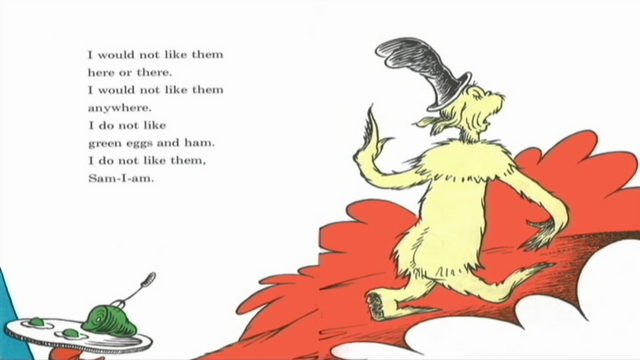
Me? I don’t like Macros. And I’ll say it in the exact voice and hand gesture as Sam I Am up there in the picture. I DO NOT LIKE MaCROS. I would not eat them with a fox, I will not eat them in a box.
My problem?
It’s just so…so Bro.
Recall I’m a crossfitter. I love the whole cornucopia of workouts and experiments and plans that accompanies crossfit. I like the fast forward evolution. I love the silliness of it all too. The silly socks and crazy patterned shorts and yelling out a scream like I’m at a college football game just to be funny. Most gyms frown on that type of behavior and my gym giggles like the rest of us.
Crossfit has a very distinct “lifestyle.” Much like other high school style “cliques” such as Goth, rockers, and Jocks you can sense a crossfitter from a mile away.
My point is, crossfitters stole and 100% adopted “macros” from bodybuilders as an eating plan of choice about 5 years ago and well…collectively they got RIPPED. A no brainer..the eating plan of bodybuilders made crossfitters look more like bodybuilders. Yep, science. It works.
But I wanted to puke every time I heard my fellow crossfitter buddies talking about their macros and how the hit their mark and were on point today. And when I had an off workout or a slight headache immediately asked me, “Where you at?” as in “where are you currently sitting on your macro ratios today?”
I HATED it. Ok not hated but just got sick of it.
Macros is an eye rolling, meh, birthday gift of socks type of excitement for me. It’s boring.
But…it works.
But it’s vanilla. It takes a conscientious effort and you have to pay attention.
IT SHOULD BE MY DREAM LIFESTYLE OF EATING… I constantly harp on this page about paying better attention to yourself, to make yourself better. Awareness, track it, pay attention, experiment… And Personally, I do. In almost every category in life…Except food.
MY Problem with Macros…I just want someone to do it all for me. Just get it all together and I’ll eat whatever when you tell me to. It just seems so cyborg and disconnected. For me personally, It’s just such a disconnect from food. I want my food to be more than just the components of nutrition. I want more than the macros.
So…as I’ll preach with workouts, lifestyle, clothing, music, life…food included.
Heck, what this entire website is built to personify:
Whatever you’re looking into – It has to work for YOU or it just doesn’t work.
This style of eating takes work and takes a conscious effort, something we, as Amercians, typically lack the patience for. It might be YOUR absolute BEST plan and it is well worth the time and effort to play with.
I have played with it. I have the ap and have tracked my calories of each macro and see results.
It should be my dream system, it’s just not. but…Now you know what it’s all about, so you can make an educated decision and hey man, if it fits for you, I’ll be seeing you and those rock chiseled abs at a beach sometime soon!
I’m in the middle of soccer, baseball, softball, and Ninja Warrior season. So, both as a dad and as a coach – I’m involved! I have a career as a sports-based chiropractor but spend a significant amount of my time and energy on human performance. I love helping adults and kids become faster, stronger, and more energetic. It is a passion of mine, and after 4 or 5 generations of coaching, I feel like coaches and teaching is in my genes – especially for the age of my kids and their sports teams.
Parents often say, “It’s nice to have you coach because we can tell our kids what to do, but they won’t listen.”
That’s true. It’s difficult to be an expert to your own kids.
Watch my teams. 10 kids are paying attention, fired up, and ready to work, and my two girls are doing cartwheels 20 feet away. I’m no expert on them. I’m the dad – not the expert. Barely the coach.
The other kids might think I invented the sport and what I say is GOLD –
but let’s get real….I’m just DAD to my kids.
This may happen to you as well. Especially the young parents that have their oldest in sports for the first time,
“Why won’t she listen to me??!! I played college ball, for crying out loud!”
Don’t be discouraged. I have figured it out, and I can help you. I use my friends (coaches) as my kids’ experts. I used to have an issue with this, but I’ve seen the light and learned from my mistakes.
Look, I’ve done dozens of Tough Mudders and obstacle courses, I’ve taught courses on how to train for these events, hell, I built the stuff in our backyard they play on, but still – NO advice from Dad, please.
Guys, it’s no big deal. Stop worrying and see it from the kid’s perspective, and you’ll see why – for millennia, parents have RARELY been the experts. Even the best coaches in the world use outside help.
Little known fact – little Vito Columbus, Chris’ kid, learned to sail from one of his friends. Not his dad. It was pretty much peer pressure alone that made him, although lesser known – equal in longevity, sailing career profitable and secure.
Here’s why:
They’ve seen you in your underwear.
That pretty much sums it up. How can you be an expert when the kids know you like that?
They’ve seen you in the shower,
swearing while tripping on Legos,
in the morning before the coffee has kicked in,
hungover,
cursing after you stubbed your toe,
Irrate over some little insignificant thing like clothes on the floor,
swearing again about another item not picked up that you stepped on
– whining, begging for them to “Just. Go. To. Bed…Please.”
Basically, everything that entails being a parent.
We are intimately tied to our kids, and this is a GOOD thing, but it does lend itself to familiarity and comfort– both traits that keep you from being the end–all–be–all expert of the universe.
And let’s get real, the actual job of parents is in the comfort and familiarity department. That’s social development homey.
The real stuff.
Confidence and Security.
That’s OUR job #1 and something to be proud of.
Our kid hitting the slider can take a back seat for a while.
Have you ever noticed how your kids get when they see their teacher at the grocery? Kind of goofy and “straighter.?”
That’s because teachers haven’t been considered real people with real lives. “Wait? They don’t just live at the school and think of nothing but furthering the human race through the education of my classmates?” Teachers are experts.
Use this information. Be OK with it.
You still are the person they trust and love the most, and they will always come back to you. Be the one that supports what the coach says and helps reiterate the lessons they need. If you really need to drive home a lesson, just ask the coaches to bring up something you want to instill.
Your kids’ universe is different than yours. Their perspective is different than yours, and the same information coming in different ways helps reinforce the lessons they need for sports, life, love, family, and development.
These little guys and girls are observant.
When they see others listening to your advice and ideas, they’ll eventually get the point and understand that you know whatever it is you’re yammering on about over there. No matter how they act – you’re still mom and dad. The smartest, strongest, kindest, and most special people in the whole world. Even in your underwear.
Chad Peters is the author of “Parenting from Out Of Bounds” a book for parents coming out soon.
Follow along his wild family adventures @ The Texas Zoo Crew (insta) and Texas Zoo Crew (fb)



 nother classic in the “how do I hack my eating” – the term Macros is getting a lot of play in the diet world again so I wanted a record of it on my site.
 (3 min read)
