
I have been seeing a ton of Plantar Fascia, foot and ankle issues in the clinic lately.
It’s true – the Universe runs in waves and we’re on a big wave of these issues.
First thing’s first, these issue are treatable and if you are willing to put your time into some basic at home rehab and exercises you can speed the healing of this issue up considerably.
If you’re willing to just take a couple minutes to learn a little I can all but assure you will respond EVEN quicker.
Read this article prior to deciding to stick to any plantar fascia treatment plan. Understanding makes a HUGE difference in WHAT treatment you end up doing…and most of it out there has 1 GIGANTIC FLAW!
This is a condition we see in the office a lot and have had good success with it. It is not usually a “quick fix” issue however. Typically one treatment doesn’t make a huge difference and I think that’s why there is so much jumping from clinic to clinic and so much MISTAKE and disappointment with treatment and expectations.
You need to understand the issue and the foot…and the body, if you want to fix it and you really need to understand the rules of treatment so you understand what you are trying to accomplish. There is an order to the treatment. If the first step isn’t taken care of before the second step you’re just spinning.
This issue as much as any other condition we see is OVERLOADED with mis-information.
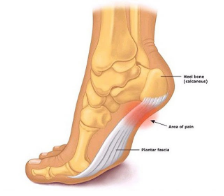
At the heart of the problem with treatment of PF is the name itself – collectively, Fasciitis (as well as any –itis) has multiple, different issues that are collectively called Plantar Fasciitis – see the picture and how large of a tendon, fascia and muscle we’re dealing with? Technically, almost any issue to this area with cause inflammation of some sore (itis) and now you’ve got a diagnosis.
This problem with this is that I could come up with 20 different issues are of which are typically called Plantar fasciitis. 20 different injuries need different treatments if they are going to be successful.
You’ve got to dive a little deeper than, “this is what FB told me to do.” You have to know what is happening that is screwing up the function of the foot… IE: “what is causing the –itis?” The twist is, it could be a few things.
It’s not that your friends, magazines, therapists OR hear-say is wrong – it’s just not specific – its giving you general information and you may not have the exact same condition.
So if you’re looking for, “Doc, what exactly do I have to do to fix this?” I can’t help you on a blog or podcast – it’s going to take a little trial treatment and a lot of homework to get you to the right protocol.
There is good news though! Despite 20 different versions, many times, just doing treatments in the right order and restoring proper foot, ankle and then hip function will take care of the problem. With this article, I will give you some basic ideas that seem to really help out the healing time and speed up recovery – general stuff that is a part of my “Rehab to Go” stuff for you to use at home.
OK, so let’s dive in. In almost all cases of PF it’s not so much the pain, but the lack of proper function of the foot and hip that is a major obstacle in the recovery of the issue. Add to that – the lack of function is coming from some poor mechanics and form. Now we’re getting down the rabbit hole! This is why an injection or one or two treatments don’t fix this.
That’s why you won’t hear me push orthotics, braces and long term rest as part of your treatment protocol. I don’t like them for 99% of cases.
I’m not saying there isn’t a place for these but my protocol really pushes function and mobility as the key component to recovery. Let’s face it; Function and mobility need to be present before proper stability and healing can occur. Let me repeat that, Function and mobility need to be present before proper stability and healing can occur. Read it again and memorize it…that’s what this rehab focuses on.
My rules of at-home treatment
The most important rule being the one that is most often neglected!
The order of application makes a tremendous difference.
If you start rehab prior to getting the inflammation away I have seen next to zero recovery from this issue. This is such an important factor that I cannot emphasize it enough. It is why I think the majority of rehab treatments for plantar fasciitis tend to fail.
Step 1! You need to get the inflammation out prior to any start of rehab.
The stretches, the balls, the tools, the manipulation and mobilization needs to happen as the inflammation is under control and done. Why do you think cortisone is the recommended injection from the podiatrist? It is an anti-inflammatory.
Often times when the inflammation is under control the pain also decreases or disappears- now is the time to start doing rehab. It blows my mind how often I hear in my clinic, “ I had this issue a few years ago on an injection made it go away.” No – the injection stopped the inflammation – the problem still remained. Cortisone doesn’t stop your crappy running form Karen.
This time around, plantar fascia version 2020-let’s do it better, more thoroughly, finish the problem and then start to dive into how feet should function and move.
Ice – I prefer a frozen water bottle so you can strip out the fascia at the same time. This needs to be done DAILY. And keep working it until numb, usually 8-10 minutes. Work the fascia out with the ridges and contours of the bottle. (as seen on this bottle)

You will get to the stage you might not need to do this, but you can’t go wrong here – if the foot is inflamed you need help putting the fire out!
step 2) shoe wear.
Don’t use flip flops while there is pain. Look, flip flops aren’t great. They make your big toe move incorrectly and then the foot is screwed up. I get it though, they are easy and practical and a common part of our days- people just won’t give them up.
Flip flops and dare I say it? Shoes in general, just jack up your motion man. They also force the foot to bend as one piece at the push off phase and this limits motion and rotation. This keeps the function of the foot less than optimal. Keep the flip flops if you have to, but save them for when your foot is fixed.
Limit your orthotics – (cough.. throw them in the trash)
This is where I get the most resistance in my office – these things are expensive, most likely ordered from a pro and you like them – I get it. But, the built up arch supports limit full ROM. This really helps with pain initially but keeps perfect and proper motion which is vital while trying to fix the issue. Its vital to human movement.
Same reason I’m not a huge fan of the slings and braces – I want motion! There are a few main arches in the foot and we want them mobile and functional, not limited! If you guys are in love with these things, keep them with you but try hours on and off and see what works better. Remember these are general rules of rehab, not laws and absolutes, everyone is different, but this seems to work in our clinic much faster than staying in them 24/7.
As I dove into the foot function more I found a group out of Canada made up of some fantastic physio’s that just have a knack for telling it like it is. The group TFC (The Foot Collective is definitive worth your time if you want to really dive into it.) They are very like minded, as our nearly all of the modern era progressive foot people. To paraphrase TFC, “So you have super stiff and immobile feet huh? It’s killing you to walk? Why in the world would you treat stiff and immobile with more stiffening and more immobility? Get moving things moving again! That’s your treatment.” TFC, as well as myself recommends going barefoot as often as possible.
3) spell the ABC’s with your foot – Especially first thing in the morning –first two steps hurt like crazy and the fascia is restricted and stiff. Get back into bed and put your foot through a full alphabet of movement. This isn’t a fix but at least you put the foot through all kinds of great ROM and it helps move the tendons, bones and fascia. This usually at least gives notable relief on the first agonizing steps out of bed.
4) Force Foot, Toe and ankle motion – This is where again I would check out TFC. https://www.thefootcollective.com/ You need this. They are the best in the game. Wiggle your toes, make a “foot fist”, rotate through the ankle not around it…etc.
TAC balls – (link to chadknows video) use motion in all planes – look again at the picture of the foot and the different arches. Think of the inside of the foot, navicular bone specifically and the outside of the foot, the 5th metacarpal and cuboid bones.
Follow these steps: (with ball) Barefoot is best as these specific balls (TAC BALLS) have some grip and work the fascia better than a Lacrosse ball or tennis ball.
- Roll the ball from the front to the back – the length of the foot (not back to front however)
- Heel down, toes up – pivot shift side to side on transverse arch
- Inside of arch (navicular) – Smash and Shimmy then extend foot and toes
- Outside Mid Foot – Smash and Shimmy then extend foot and toes
- Ball of Foot – Clamp Down and squeeze ball
- Separate Four toes and Big toes – separate squeezing
- Heels Down, Toes up- pivot and shift on ball of foot
- Using your hands – work the toes, foot – knead and separate
This is a 2-3 minute process – work it, love it, get to know your feet – Get your feet back!
Usually there are other issues such as low back, hip rotation issues (every time), calf and anterior tibia strength ratio issues and others. Then get to the cause – what are you doing to cause this. I’ll fix this in 30 minutes in my clinic and you’ll undo this for the next 10 hours daily. It’s a net loss and a comlete loss over time. You need to fix this. TFC recommends 2 minutes, 2x/day of self work for a minimum of two weeks as the MED. I’m stealing this as our clinical protocol as well. Easy to remember and apply.
I’m guessing this isnt where you are at right now. Experience tells me most of us are trying “mash the hell out of for a day and limp around the next two or three days and then say, “it’s not working”
version 2020 – have a better plan!
Its a monster of an issue but that doesn’t mean you cant fix it. I hate to tell you brother, but you’re going to have to handle most of the work yourself on this one.
Just like everywhere in the body, one thing leads to the next. There is a systematic and bigger approach to fixing this condition than just attacking where it hurts. We say in the office all the time, “The victims scream, but the Culprits hide!”
Remember that 20 different issues are all called the same thing they are all PF and these 20 different injuries need different treatments if they are going to be successful.


