There’s a unique situation that happens in the modern world at the high school level of Athletics that I think a little bit of discussion would dramatically help with:
Your kids and how they deal with the athletic trainer at their school.
And by your kids I mean; your kids, you, the doctor or PT you use, and how you handle the entire episode.
As the guy that based his entire professional career on his relationships with some fantastic athletic trainers and sports docs he met during my sports career, I can’t stress to you enough the importance of building a good relationship with your athletic trainer.
As college athletes, Nikki and I LOVED our athletic trainers. We wanted their job. That is of course until we saw what their job entailed. Then we wanted a similar job with the same direction and protocols but done in a different way. Damn, those Athletic trainers work! Hard.
So This goes for you as an athlete but also as a parent.
Even if you aren’t on a first-name basis with your athletic trainer, know this. These guys/girls are here to go to bat for your kid in a time of need. They are there for protection, treatment, workups, and as a first line of treatment in an emergency. This year more than at any other time in history, it has been shown that ATs make a difference. They save lives, speed recovery, win super bowls, change protocols and care. They care man!
They aren’t out to make your kid sit on the bench and miss playing time.
We are in a very fantastic time in history – safer, healthier, more access to entertainment, less starvation and poverty worldwide, medical care is accessible – even at the high school level, most districts have an Athletic trainer right there on staff, typically at each game and with a full functioning clinic just down the hall from the locker room.
It is a fantastic first line of sports medicine care.
Having that doesn’t always make for perfection, however.
Some nuances are quite distracting and tough and make easy to go to “right answers” tough.
This article is not an attempt to fix all problems in all cases because that’s what I feel is a massive problem in the world. Each case is different. Oh, they aren’t all unique per se – Do this work for a decade, and you’ll start to pick up on trends, see a lot of repeats, and get a system. I certainly hope so. Every profession should get more efficient and better at categorizing as they get more experience. Athletic trainers, coaches, administrators, sports-based chiropractors, orthopedic surgeons, and everyone in the sports medicine universe should be able to come up with a Direction within the first minute of evaluating and watching an athlete and injury. That’s common sense.
Let me dive just a little bit deeper.
As a sports-based chiropractor, I interact with athletic trainers from all sorts of different districts with different policies and different personalities daily I have my favorites. I have the ones that are easier to work with. But I also have the ones that take a specific response and reaction, and I am constantly evolving the way that I handle each and every one of these relationships.
Being stubborn and just stating in stone: “I’m going to handle them all the same way.” is not only being selfish and nonpliable but is a sure way to get many things wrong.
Just like every profession, the interaction between athletic trainers, coaches, and anyone in the sports medicine team needs to be individualized and personalized. That’s true with the athletes, parents, radiologists, PT’s and orthos as well, It’s about relationships.
So I’m going to give you a scenario that I go through nearly daily.
Where you fit in on the Spectrum is entirely a matter of perspective.
An athletic trainer with specific guidelines and protocols and legal liability needs that have to be followed will have a different perspective than the mom who just wants her kid to play in the game on Friday. The doctor, pediatrician, chiro, or PT in the loop will have another, and let’s not downplay reality. The athlete, who by far and away is the most critical person in this equation, will have a different perspective that may change hour by hour based on ideas such as pain, the opportunity for play, team, drive, stubbornness, fear, as well as a million other emotions and thoughts that are in fluctuation faster in adolescents than we can even remember or comprehend.
In nearly every article I write, I talk about AWARENESS and how important it is. How we function in all aspects of life based on our awareness. A different perspective gives us better awareness and lets us make better decisions.
As much as I would love to have some discussion and would love to see some chats after one of my articles – just take a second to think it through from at least three perspectives before you write in the comments section. THEN….please write. I’d love to scenario strategize.
Let me set up a few scenarios as I feel Learning happens quicker with examples.
A high school track athlete goes to their athletic trainer with low grade back pain after a basketball practice.
“My back hurts.”
The athletic trainer states:
“We have a policy at this school. If your back hurts, understand that you are at the age that a stress fracture at the lower lumbar is a fairly frequent problem. You need to sit out until you have been evaluated by an orthopedic surgeon or someone that can sign off on a form saying that you do not have that issue.”
The kid is out of sports from that second on. That stinks. But it can happen. It does, and at some schools, that is THE actual protocol. For damn near every issue.
The reality is:
That’s a fair protocol. Nothing the athletic trainer said is incorrect. However, there was no exam or evaluation. In a case like this, there’s a strong possibility that if one minute would have been utilized to better evaluate an athlete, I think a better decision could have been arrived at quicker. Athletic trainers are well-trained and have mountains of experience with low back pain in athletics. They can and do judge and are way better at this kind of decision than anyone gives them credit for. So when I hear this, I cringe. “C’mon man, make a better decision!”
Contrastingly, as someone that does this for a living daily and has two decades of experience, I can almost guarantee you, examination and evaluation questions such as “Show me where it hurts, Grade the pain on a scale of 1 to 10, can you bend over?” Arent sufficient enough to truly make a good call as to the athletes state of being.
So what’s the right answer? Every single kid that has back pain needs an MRI?
The truth is MRI isn’t even the right call for MOST back pain. It’s used. It’s looked at as THE ANSWER. But it’s just not. It can show some things that we cant evaluate but it’s simply a picture, much is lost as a picture doesn’t show MOST.
The reality is that MRI probably takes two to three weeks to even set up. They are expensive. It’s most likely Overkill as nearly every single athlete has back pain at some time anyway and even could lead you down the wrong path. Its needed and I use is multiple times per week. But for every case? Even if it was free and took seconds…No. It’s not the only factor in proper decision making.
Like I said, it’s a case-by-case issue.
The honest reality is that a complete examination, evaluation, and treatment may allow us to decide on a treatment protocol that might show some results. We can then use these ideas to make better decisions but only after seeing if the athlete has responded to our care. I say daily, “We’ll know a lot more after seeing how this guy responds to the treatment.””
Just like the MRI may be overkill, sending that kid to a chiropractor or physical therapist who demands 16 sessions and four weeks of therapy before returning them to Competition damn near cuts off their entire season. Most likely, it is overkill. Unneeded.
Yet there is always the potential that something more serious is going on and as a parent, coach, coach, AT, or doctor we want to make sure that we can discover any issues as early as we can to protect the athlete and maximize their return.
That’s why policies are in place. Bureaucracy. Better ideas -only, a slower timeline.
This is why I have no hair.
Because in the everyday situation I explained above, the reality is this: If this “referral cascade” happens repeatedly in an athletic training situation in high school, parents, athletes and coaches will often start to avoid the AT.
Every day I get a call from an athlete who has an issue that has not seen the athletic trainer and the parents directly ask me not to speak with the athletic trainer on this case. Even though by working together, we can maximize the recovery time and the safety for the athlete, they want to have their kid to be seen “out of the loop.” Typically in an effort to speed their return to play.
Now let me add some more reality.
In the case above, the athlete who has hurt her back and goes the athletic trainer.
What changes if the report that the athlete gives the athletic trainer sounds like this, “ Hey doc, I hurt my back. Can you look at it?”
AT: Of course, How long have you had the issue?
Athlete: On and off for about a year and a half.
BANG!
Honestly, nothing has changed. Same idea but stated with one nuance.
If this athlete is a junior in high school, more than likely, during the course of Athletics, she has had back pain on and off for a year and a half. It may not be severe, most likely it is nothing, but the terminology alone almost demands that the athletic trainer takes a different look at the injury. That statement, “on and off for a year and a half” demands a better look. Even if it is nothing more than tight muscles that come and go with the tossing and turning of being a teenager, staying up till midnight studying for exams, and then playing football games. Nothing has changed other than the way it is reported.
This is where the reality and the difficulty of the situation comes from.
These are real-life things and real-life situations that I see every day. The parents call or text and ask, “Can you give me a release so my kid can do Sports?”
I want to. Most of the time if they have my personal cell, they are friends of my kids. i probably coached them in sports and know that they are just sore from doing 3×5 squats heavy on Wednesday. But, there is liability. What if it is something serious this time? What if I sign the form or call the AST and tell them they’re good to go and the kid cant move by that afternoon? Do you think that if a kid told me they had on and off pain for a year and a half that I would just sign a form releasing them that day?
Because of the way it was reported and the way it was stated, Everything Has Changed.
Just take a minute to think About how this changes the athletic trainer’s perspective and the doctor that now needs to sign off on the state of the athlete.
Because there’s another reality in this relationship.
Despite being very good at sports medicine and doing a lot of discussions, treatments, muscle work, exercise protocols, and just overall great Sports Medicine. The perspective the athlete often has is this: “ The chiropractor popped my bones/ the athletic trainer put stim and ice on me.”
Trust me when I tell you, that’s not what is going on.
I can go on with a million examples, but that’s not what this article is. Before I leave, I want to just add a couple caveats.
What happens when the athlete reports to the athletic trainer?
“ I heard a pop in my knee.”
“ I landed on my head and now I feel dizzy”
“Don’t worry doc, it’s nothing, Can you just stretch out my back?”
“Is there a tape job you can do for my ankle?”
As a parent, I want my athletic trainers, nurses, orthos, coaches, strength trainers and everyone involved to just give a damn.
But my perspective and what is said make a difference.
As we reach the end of this article, that seriously could go on for an entire morning lecture at a conference (hint:I’m available for presentations!) please get the point:
It’s about how we react and teach our kids to talk to those around them that make a difference.
And it’s 100x more critical now as text messages, despite being so much more convenient AND being the primary mode of communication between everyone, lack the significant handicap of being unable to inflect tone. So “It really hurts” doesn’t mean much via text. Or it could mean something serious.
“I heard a pop in my knee while landing in hurdles.” – as a text can be read a dozen different ways. This is the impossible situation Athletic trainers, as well as the rest of us find ourselves in more and more frequently each day.
Honestly, as I write this article, it is 10 am. I have had 4 text messages from friends/clients showing different body parts. Ex. a picture of an elbow with a finger pointing at it. “Hey doc: Elbow pain; what should I do?”
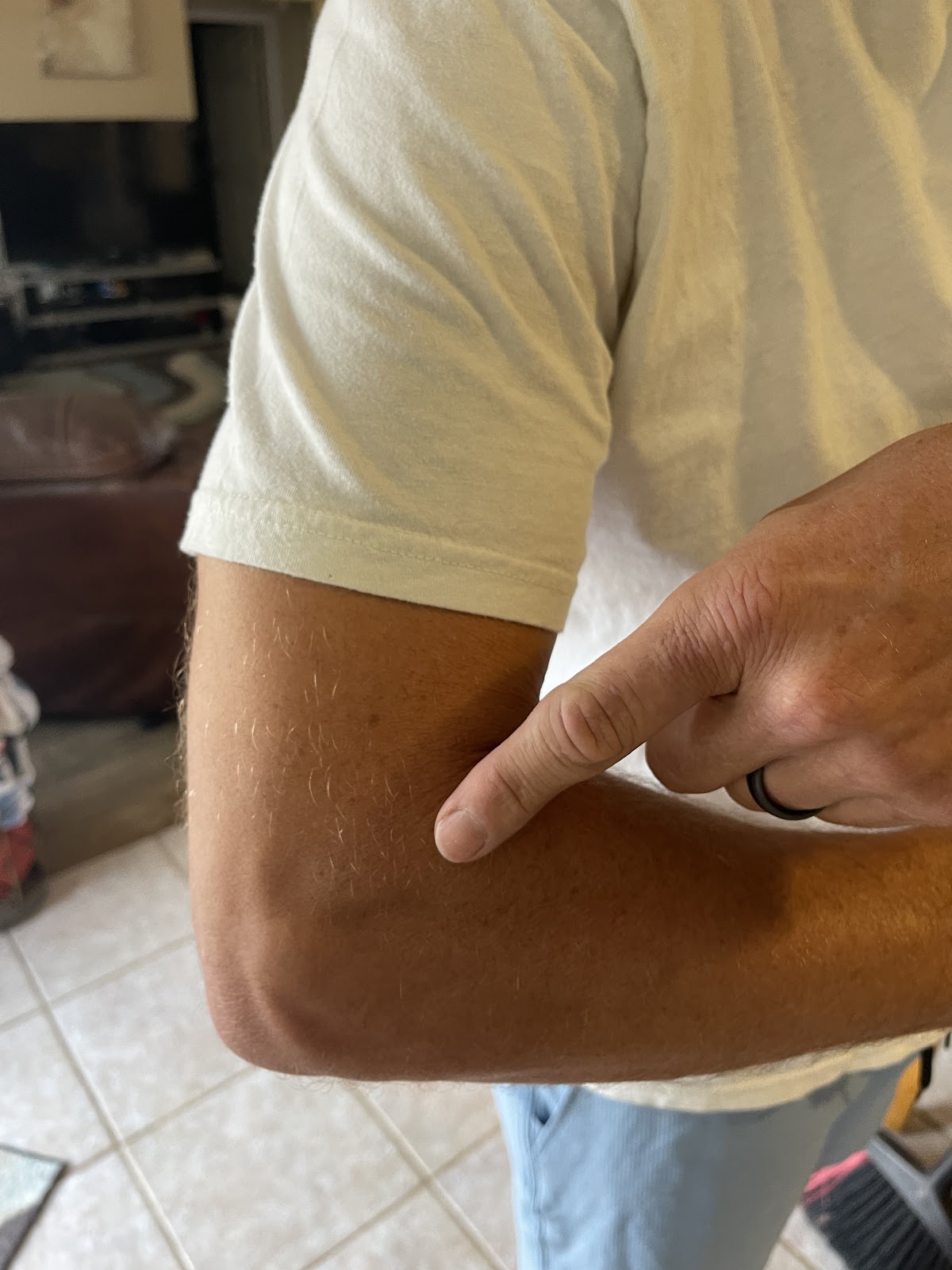
Understand the importance of this. It’s impossible. Teach your kids to communicate better with athletic trainers. Understand liability, bureaucracy yet at the same time realize they want the best for your young athlete.
The days of, “Just stick them in there, we need a first down.” have been gone for a long time. Nobody does this anymore. At any time.
Nobody: No coach, no athletic trainer, no booster wants a kid that is injured, to play. It’s not worth it. But we have to filter out some level of pain that is inherent in sports and practice and decipher from severe injury and the reality is, “IT DEPENDS”
The truth is, as a sports med team, the best approach is nearly always, “Here is what I feel is going on, lets proceed this way and really evaluate what we deemed was the best approach. Is the athlete responding as expected? Is it worse? Should we change our approach?”
If you are even a little interested in this article I’d strongly urge you to look at one entitled “Return to Play.” as a great model for recovery as the idea of “rest 4-6 weeks and then try to come back and play” is perhaps THE WORST recovery mode, yet often the most prescribed from a clinic.
As a parent, don’t forget that the ATs and coaches are there daily. They are much better equipped to evaluate your athlete’s recovery and ability than a clinician in an office despite the 6 degrees hanging on their wall. There is no way to replicate movement, change of direction, balance, acceleration, speed, or mechanics in a clinic despite all of our best tools. The BEST way is the professional athletics way, where all of these guys are out there at the exact same time and have worked together for years, so communication happens at a near-telepathic level – but that’s not a reality for the majority of us. It’s not possible – so we have the next best thing. Your athlete is getting that.
Or I certainly hope they are. Just like every career, some are over worked, lazy, burned out, thinking about their personal lives and their own finances and marriage and their own kids. There is real life all around every person you meet – but for the most part – we’re all trying our best – athletic trainers and sports docs included.
Get that perspective.
Teach your kids to communicate better.
Understand logistics and reality.
Be mindful that we all want the best for your kid.
And be cognizant that your particular case, despite being your kid, the most critical person in the world, is most likely not unique nor even uncommon and that we have the experience to handle this in what we believe is the best outcomes. Oh yeah, and in line right behind you are ten more kids with a similar situation.
We’re all doing our best in a dynamic, stressful, emotional situation that we know we signed up for because we love doing it. It’s our job. It’s our passion. But sometimes, it takes a bit of time and decision-making. Better communication is a critical step that happens on your athlete’s end. “It just hurts” is a time waster and a slow process.
SportsDocDc is Dr. Chad Peters DC. A sports-based chiropractor focusing on sports performance and recovery for athletes. He works hand in hand with some of the best athletic trainers, PTs, orthos, and radiologists in the area. He is always striving to make the treatments, flow, and protocols more closely aligned with what is happening a the professional level.